Dispatches from Ukraine: by Julian Do, Associate Reporter of SlavicSac
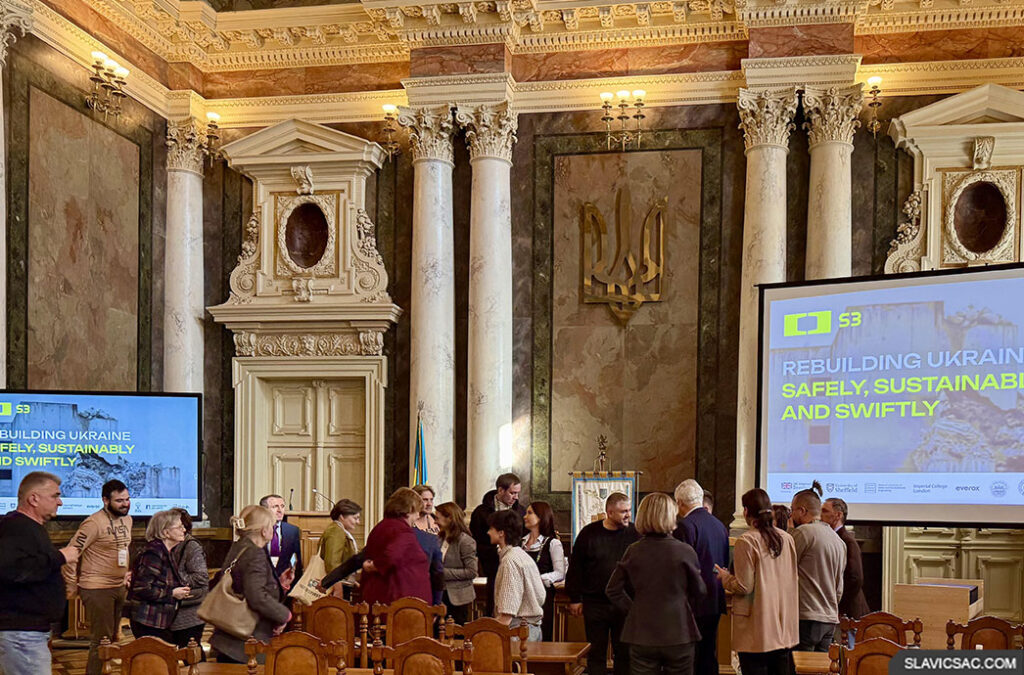
The grand hall of Lviv Polytechnic National University (LPNU), currently celebrating its 210th anniversary, offers a striking juxtaposition: 19th-century Western Ukrainian architecture infused with a 21st-century drive mirroring the Silicon Valley’s mantra of “move fast and break things”: Time is of the essence. High-speed action is essential to dismantle outdated systems and rapidly implement new ones utilizing cutting-edge technology.

This is all befitting at the just concluded S3RoU (Safe, Sustainable, and Swift Reconstruction of Ukraine) conference (March 19-20), hosted by LPNU, where the participating scientists, researchers, and government leaders discussed innovations and approaches to pulverize and transform concrete waste from war destruction, into new, resilient building materials. These “siliconeers” not only want to reconstruct but push Ukraine to the technological frontier by using high-tech additive manufacturing to establish a “circular economy“.
Even as the daily 9:00 a.m. nationwide moment of silence falls over the city to honor the fallen, momentarily quieting the distant rhythm of air raid sirens and power outages, this “can do” spirit is bolstered by the dawn of a special relationship between Lviv and California—now the world’s 4th largest economy.
The Ruins of the Invasion, Reborn
About nearly 100 delegates, in person and via remote satellite, participated in the S3RoU conference. This gathering – supported by UK International Development and many leading universities such as Oxford, Leeds, and Sheffield and research institutes including
ACI, ISCOWA, and RILEM – has transformed LPNU into a practical laboratory. The mission is an unflinching look at the “circular economy” of war—the brutal reality of turning the ruins of an invasion into the foundations of a green future.
“For Ukraine, this project is a new level in waste management,” says Dr. Oleksii Hunyak, PhD, the project coordinator for LPNU, gesturing toward the displays of recycled aggregates. “It allows us not only to effectively rebuild destroyed structures but also to do it more safely and sustainably… turning destruction into hope and innovation”.
Professor Taras Markiv (LPNU) adds in his remarks:”Support from the West is essential.” He explains the advanced innovations enable researchers and leaders to study construction materials in greater depth, leading to more accurate and impactful conclusions for Ukraine’s recovery.
Dr. Maurizio Guadagnini, participating via Zoom from the University of Sheffield, says that holding the conference in Lviv and at LPNU was “invaluable” to move beyond mere project goals and into the grit of circular construction.
The Lion (Lviv) Hugs The Bear (California)
This vision is energized by an event thousands of miles away in Munich a month earlier. On February 14, 2026, Governor Gavin Newsom sat across from Lviv Deputy Governor Oleksandr Kulepin to sign a historic Memorandum of Understanding (MOU).
Through a press release, Governor Newsom states: “Today’s partnership between California and Lviv showcases the role California and its companies will continue to play in the rebuilding and resiliency of Ukraine, including in healthcare, energy, agriculture, defense, infrastructure, and emerging and digital technologies”.
Lviv Deputy Governor Oleksandr Kulepin, from his official statement, responded:”This partnership is not just about recovery, but about building the future of Ukraine using the world’s most advanced innovations. By connecting Lviv’s industrial potential with California’s high-tech leadership, we are creating a bridge for sustainable development and long-term economic sovereignty.”
Newsom emphasized that as international alliances strain, California remains a “stable, reliable partner” that proves growth and security depend on democratic values.
Building A Bridge
This is more than policy; for the 114,000+ Ukrainian-Californians, it is personal. Through the Lviv-California Chamber of Commerce (LCCC) and its 2026 strategic plan, “Building a Bridge,” Lviv is being established as the “soft landing” hub for Silicon Valley innovation. The Bridge initiative will also transform the diaspora from distant donors into active stakeholders in reconstruction projects.
The Take Away
What we are witnessing in Lviv is more than a potential reconstruction blueprint for Ukraine; it is a technological defiance and promising economic development model for other post conflict and disaster regions around the world. A “green recovery” is seen as the most resilient path to national sovereignty.
About Author: Julian Travis Do, based in Orange County, California, is an associate reporter for SlavicSac and the Co-Director of American Community Media (ACoM). His dual-sector expertise bridges digital media transformation and international trade. With a background spanning electronic manufacturing and private equity, he provides unique market intelligence on the dynamics of America’s multicultural communities and the burgeoning trade corridors between California and the Ukrainian diaspora.