
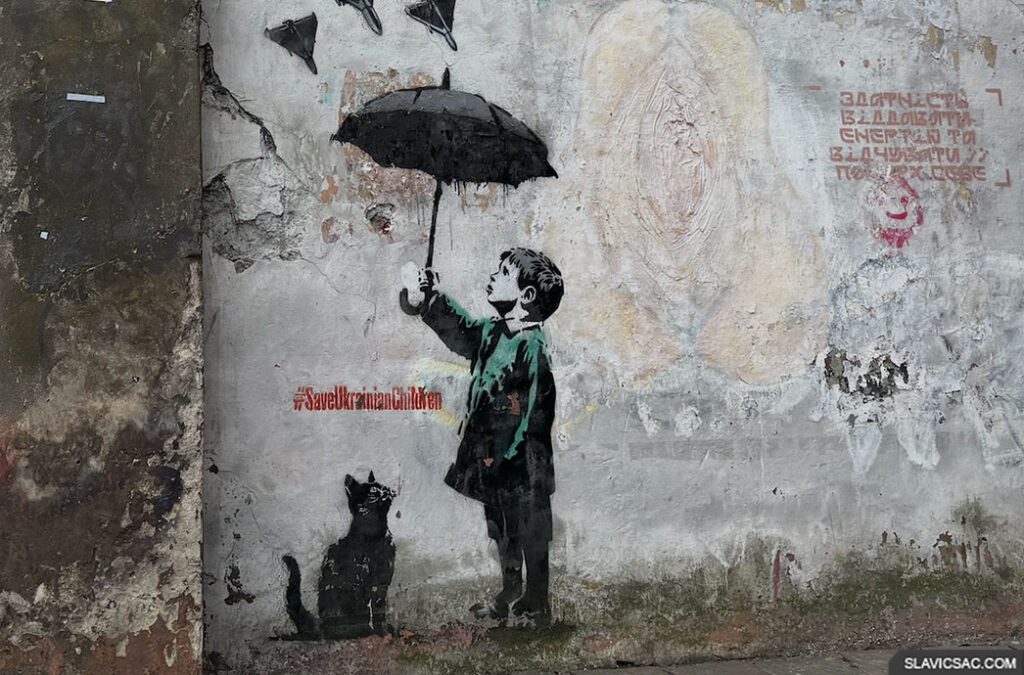
Julian Do, co-director of American Community Media, shares insights from his recent trip to Ukraine, where he attended an international reconstruction conference in Lviv. Speaking with Slavic Sacramento editor Ruslan Gurzhiy, he highlights the resilience of the Ukrainian people, discusses innovative “Construction 4.0” technologies, and notes the significance of a new trade agreement between California and the Lviv region. Drawing parallels to his Vietnamese heritage, Julian Do expresses optimism about Ukraine’s future and emphasizes the important role of the global diaspora and international partnerships in rebuilding a modern economy:
Julian Do: My name is Julian Do. I’m co-director of New American Community Media, and also I’m an associate reporter for Slavic Sacramento. On my recent trip to Ukraine, I was a reporter for Slavic Sac, and I really found this opportunity to learn about what’s happening in Ukraine, and it was also a personal journey for me as well.
I had an interest in development, especially in areas that have experienced conflicts, just like the situation in Ukraine. So there was the first international conference on the reconstruction of Ukraine, and it was held in Lviv, on the western side of Ukraine, not far from the Poland border.
So I thought this would be a perfect opportunity to visit Ukraine during this period to understand and see for myself on the ground what’s been happening in Ukraine. But at the same time, this unique conference gave some ideas and visions about how the reconstruction of Lviv should look.
This was my first time to Eastern Europe, visiting Poland and Ukraine, although I had heard so much about these Eastern European countries during the time of the Soviet Union. And there is also a personal connection for me as someone who was born in Vietnam, a country that also had a relationship with the Soviet Union during the Cold War.
Ruslan Gurzhiy: Tell us a little bit more about your purpose in Ukraine. Is there any new special, innovative technologies that you learned about on how to reconstruct those buildings that were hit in Ukraine?
Julian Do: There was the first international conference on rebuilding Ukraine, but it was not just about the general idea of reconstructing Ukraine, but also specifically in what way Ukraine should be built. It was hosted by Lviv Polytechnic National University because they wanted researchers, scientists, and developers to think about rebuilding Ukraine. It should not be the same way that it was built before.

So the conference was about exploring new technologies that can be applied to Ukraine. So instead of just the usual reconstruction of buildings with concrete and so on, how should the new Ukraine look in terms of new technology in rebuilding? But also taking into consideration the circular economy, climate change, and environmental issues, and so on.
Ruslan Gurzhiy: I heard you experienced an actual attack while being in Ukraine. Could you please tell us a little bit about that?
Julian Do: Yes. On the first night when I arrived, there were long siren alerts telling people to immediately go to bomb shelters, and luckily for me, I rented an apartment right across from Lviv Polytechnic National University. The university has a bomb shelter in the basement, so immediately I went to the bomb shelter with many other Ukrainians.
The next morning, I learned that at first they thought the drone strike was going to hit the Lviv train station, which I had just left only two hours prior, but actually it struck the national security building in Lviv. That was on the 18th, and on the 24th another strike was coming and we immediately went to the shelter again.
This time it was in broad daylight, and it hit a 14th-century monastery right in the middle of downtown Lviv. So while I was there, there were two strikes, and both times loud alarms went off in the entire city, and people immediately went to shelters.
Ruslan Gurzhiy: But what struck you most while being in Ukraine? For example, how would you describe how local people reacted to those attacks? What did they tell you about the war, for example? What would you say about that?
Julian Do: My impressions when I first visited Lviv were how calm the people were. As someone who traveled to Central America during the late 80s, during the conflicts in Colombia and Nicaragua, those places during the conflicts had soldiers everywhere in downtown, patrolling administrative buildings, banks, and commercial marketplaces.
But I was surprised when I visited Lviv that there was almost a complete lack of visible mercenary soldiers in the city. There was also a sense of calmness among the people, and I think on the surface it seemed that life just continued as on any day. But at the same time, there was a strong consciousness about the war and also an acknowledgment of the sacrifice of those who are still on the front line fighting.
I saw evidence that on a daily basis there is a 9:00 a.m. moment of silence for one minute to think about the war and to acknowledge the sacrifices of the fallen people, both soldiers and civilians. Each day of the conference we also had another moment of silence. Throughout the series, when I walked downtown, there was also a daily national mass service at the church dedicated to the military and fallen soldiers.
Each day I saw a huge number of people in the church and outside praying. Right in the middle of downtown, across from City Hall, there was also a daily gathering of residents who got together and started singing songs. When I asked people around, they said these were songs about the resiliency of Ukrainians and patriotism, and that the fight would continue.
It was about freedom and independence of the Ukrainian people. So on the one hand, there is the daily routine that people go through, but at the same time there is an emotional overlay that people are conscious about what is going on in Ukraine.
Ruslan Gurzhiy: All right, coming back to rebuilding Ukraine, how does California plan to help rebuild Ukraine? Recently we heard about our governor, Gavin Newsom. He met with Ukrainian officials in Munich, Germany. What do we know about that?
Julian Do: So, this is such an important development for Ukraine because, on the one hand, our current president is, you know, not supporting the government. But then you have a governor of California, of the fourth-largest economy in the world, publicly wanting to help Ukraine.
And because, being a governor, he cannot enter into any kind of agreement at a national level, California has signed a trade MoU with the province of Lviv, although California has been having trade activities with Ukraine for a number of years now, as well as providing economic aid to Ukraine. But this is a further formal agreement between the state and the province of Ukraine. Essentially, it’s also about the Ukrainian people.
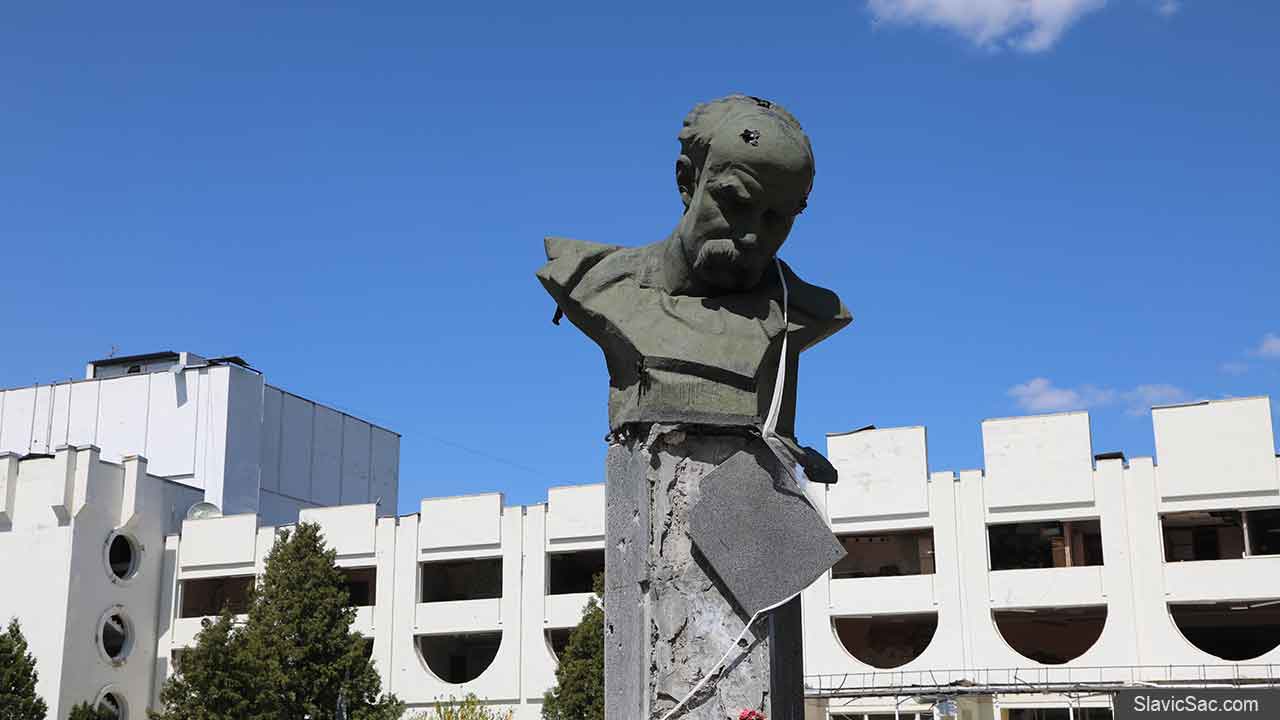
The agreement with Lviv is significant because it is on the western side of Ukraine and is the entry point for a lot of financial support and aid going through there. So that makes a lot of sense. But at the same time, with this formal agreement, it allows the state and also private businesses in California to get support from the state on how to explore business opportunities with Ukraine, as well as in the reconstruction of Ukraine.
The needs for the country in rebuilding itself are huge and vast, and California has a lot to offer. From my engagement with the official GO-Biz, they are looking at how some of the technology, from digital scanning to help with construction, with some of the leading manufacturers in California working on Construction 4.0, which is a leading technology in manufacturing, as well as some of the technology in agriculture from California.
Because of its drought and climate challenges, California has developed some cutting-edge technology in agriculture on how to grow food and crops in a way that is resilient. So that is also considered to be technology transfer, as well as in healthcare and renewable energy. California is also a leading state in developing some of the forefront renewable energy that certainly Ukraine would really need in postwar reconstruction.
Ruslan Gurzhiy: Okay. Again, being in Ukraine, how do people react when you tell them that you came from the United States, and what do they think about American aid to Ukrainian people, or maybe what they think about the current administration and their role in rebuilding Ukrainian infrastructure?
Julian Do: They were really appreciative that someone like me would take the time to visit Ukraine during this time because the war is still going on. And plus, I went there to participate in a reconstruction conference because many of the presenters actually presented remotely because of concerns about safety and security. Yet you have Americans actually attending in person on the ground.
Also, the news of the agreement between California and Lviv was so new that many didn’t know that there was such an agreement, and they were really happy to hear that because under this administration they thought that a lot of the aid and resources might not be there. And therefore, Europeans might have to step up even more. So to have an American visiting their country and participating, and also being vocal about what’s happening on the ground, they really appreciated that.
Ruslan Gurzhiy: What is your view, your personal view, I mean, of this conflict between Russia and Ukraine? Maybe you can find any similarity to what was happening in Vietnam during the Cold War.
Julian Do: I find so many similarities because under socialist systems, state enterprises play a huge role in the economy and in running the country—everything from security to food to healthcare and so on. So after the Soviet Union collapsed, many of these states had to think about what was next for them. That would be a transition from the previous socialist system to more of a market economy—a private economy.
That was a challenge because moving from something that had been entrenched for nearly half a century to something new is not easy. I saw that difficulty not just in Vietnam, but also in Laos and Cambodia. But the similarity between the Vietnamese and Ukrainians is that there is optimism and also resiliency. They believe that, given a chance, people will try to improve and work hard to better the country.
Vietnam was able to do that, though not without a lot of struggle, because I was there right at the beginning when they started the open-door policy. It took them about 20 years. I don’t think Ukrainians would need that long to move from one system to another. In fact, I think the Ukrainian economy has already started that process. And because of this unfortunate event, with Europeans and many other countries supporting Ukraine, I think Ukraine probably will be on a much better track.
Many of the scientists spoke very openly that Ukraine has agreed to be, in a way, even a war laboratory for experimenting with many of these new construction technologies and so on. With that, Ukraine can actually be a model that can be repeated in a number of developing countries in Latin America as well, and in many still very underdeveloped countries in Africa.
So there is genuine enthusiasm and interest in making sure that the Ukrainian people will succeed. And I think if Vietnam had received that initial support from the beginning, it would have been on a better track. But now eventually it is doing better. So that is the parallel that I see between the efforts of moving from one system—from a socialist system to a more privatized market economy.
Ruslan Gurzhiy: Do you have any further plans to continue working on this project of rebuilding Ukraine?
Julian Do: I do, because I share the challenges and aspirations of the Ukrainian people. I find it very similar to the people of my motherland, and I see there are a lot of opportunities for Ukrainians. Because after a while, many Vietnamese of the second and third generations like to go back to rebuild their homeland. In fact, some of the leading technologies and investors in Vietnam are actually Vietnamese Americans or Vietnamese Europeans.
I see the same with the Ukrainian diaspora who have now moved to Europe and also to the U.S. Already there are a lot of people who are concerned about loved ones back home and are making donations to help. This is what I spoke about with one of the researchers during the conference—that although it is unfortunate that you have a large number of Ukrainians who are displaced and have to move overseas, the generations who move with their parents to Europe and North America will have the benefit of attaining the kind of education that would be extremely difficult to obtain in Ukraine.
This is an incredible resource of human talent and human capital that can return and make contributions to Ukraine. We have seen that in the case of China, South Korea, and many other countries. To train somebody to have a PhD in quantum physics or software engineering can take millions of dollars. Here you have people who have already received that training and have that talent, and then can come back to Ukraine to help rebuild.
I think that is the pattern that I see. What I noticed about Ukrainians is that Ukrainian people are very patriotic, and I think that prospect is very real. I will return to Ukraine, and next time we will have more information to discuss with you!
Ruslan Gurzhiy: I hope so. Thank you, Julian!