Most people think of TV mounting as a ten-minute job: find a spot, drill four holes, hang the screen. Often the house has other plans. The type of wall, the layout of the room, the fireplace and the cables all decide how the job should be done. Here is what’s worth checking first, based on the homes we see around Sacramento every week.

Start with the wall, not the TV
Sacramento has a bit of everything. Older neighborhoods like East Sacramento, Land Park and Curtis Park have many homes with plaster and lath walls. Plaster is hard and can crack around a drill bit, and stud finders often give confusing readings through it. Ranch homes from the 60s through the 90s in places like Carmichael, Citrus Heights and Fair Oaks usually have drywall over wood studs, which is the easiest wall to work with. Newer builds in Elk Grove, Natomas and Roseville are drywall too, sometimes with metal framing in certain walls.
The rule is the same for all of them: a TV mount should be held by the structure behind the wall, not by the wall surface. That means lag bolts into wood studs, or anchors that are rated for your wall type and the weight of the TV and mount together. If the studs aren’t where you want the TV, a mount with a wider plate or a full-motion arm can often fix the problem without moving the TV off center.
Brick and stone are a separate job. They need masonry anchors, a hammer drill and the right bit.
Pick the height while sitting down
The most common mistake is mounting too high. It looks fine while you’re standing with a drill in your hand, and then it hurts your neck for the next five years. In a living room, the middle of the screen should sit around eye level for a seated adult, which in most homes is about 42 inches from the floor. Bedrooms are different, because people tend to watch while leaning back or lying down, so the TV can go higher.
A quick test that works: tape the outline of your TV on the wall with painter’s tape. Sit where you normally sit and leave it there for a day. We wrote a longer guide on how high to mount a TV with heights for living rooms, bedrooms and other rooms.
Watch for Sacramento’s afternoon sun
This one gets overlooked. Many local homes have big west-facing windows, and from spring through fall the late-afternoon sun can wash out a screen completely. Before you commit to a wall, look at it around 4 or 5 PM. If there’s a strong reflection, a tilting mount that angles the screen slightly down can help, and a full-motion mount lets you turn the TV away from the glare when you need to.
The fireplace question
Above the fireplace is often the only open wall in the room, so it’s a natural choice. The problem is height. A mantel pushes the TV up well above eye level, and the heat and soot from a wood-burning fireplace aren’t great for electronics either. If the wall above the mantel feels hot while the fire is going, it’s too hot for the TV.
If the TV still needs to go above the fireplace, a pull-down mount such as MantelMount solves most of the issues. The TV sits up high when it’s off and comes down to a comfortable height when you watch.
Plan the cables before the TV goes up
Hanging cords are what make a mounted TV look unfinished. On regular drywall, HDMI and other low-voltage cables can usually be run inside the wall to a plate near the floor, behind the TV stand or soundbar. Power cords are a different story: a standard power cord should not be run inside the wall, and moving or adding an outlet is a job for an electrician. A common middle ground is mounting the TV close to an existing outlet so the cord stays hidden behind the screen.
On brick, stone or tile, in-wall routing usually isn’t practical. A slim paintable cord cover, painted the same color as the wall, is the cleanest option there.
Match the mount to the room
Fixed mounts keep the TV flat and close to the wall. Best when the TV is at the right height and there is no glare.
Tilting mounts angle the screen down a few degrees. Good for slightly higher placement and for cutting reflections.
Full-motion mounts pull out and swivel. Useful for corners, open kitchens and living rooms where people watch from different spots.
Whatever you choose, check two numbers on the box: the VESA pattern, which has to match the holes on the back of your TV, and the weight rating, which should be comfortably above the weight of your TV.
What it usually costs
Prices vary by TV size, wall type and extras. As a reference point, Prime Mount charges $89 for TVs up to 40 inches and $119 for TVs from 41 to 65 inches on standard drywall. Larger TVs, brick or stone walls, pull-down mounts and hidden cables add to the price. Ask for a quote that lists each item.
Do it yourself or hire someone?
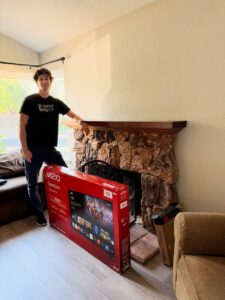
A small TV on drywall with a fixed mount is a reasonable weekend project if you have a good stud finder, a level and a second pair of hands. Large TVs, fireplaces, plaster, brick, stone and hidden wiring are where mistakes get expensive.
Prime Mount is a local, owner-operated TV mounting service in Greater Sacramento. Owner Konstantin does every job himself. Before drilling, he tapes out the exact position on the wall so you can see it and approve it, and he backs his work with a 1-year workmanship warranty. Besides standard mounting, Prime Mount installs Samsung Frame TVs, soundbars and MantelMount pull-down mounts as a MantelMount dealer.
Prime Mount serves Sacramento, Roseville, Folsom, Elk Grove, Citrus Heights, Rancho Cordova, Carmichael, Fair Oaks and nearby communities, Monday to Saturday, 7 AM to 9 PM. Get a free quote at prime-mount.com or call (916) 579-2196.