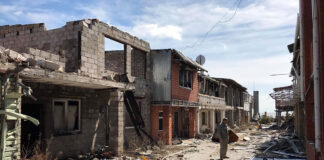
From California’s $36 billion in new housing borrowing to Ukraine’s $588 billion rebuild, money is the easy part. The capacity to build is what’s missing. | Part 1 of 2
By Julian Travis Do, Contributor to SlavicSac

Food and shelter are two of humanity’s most basic needs. Over the past century, we largely solved the production side of the first, industrializing agriculture until the planet produces more than enough food for everyone. We have never solved the execution problem for the second.
According to UN-Habitat’s 2026 World Cities Report, the global housing deficit grew from 251 million units in 2010 to 288 million in 2023, leaving as many as 3.4 billion people without secure, safe, and adequate housing.The world does not lack demand for homes, and it does not always lack capital. It lacks the capacity to build.
Two extreme cases show the problem starkly. California, the world’s fourth-largest economy, struggles to turn peacetime prosperity into housing. Ukraine, a developing Eastern European nation, is entering the fifth winter of a full-scale war with Russia. Both hit the same wall within ten days this November.
Writing Big Checks
On November 3, California voters approved Propositions 1 and 37, authorizing more than $36 billion in new borrowing for housing: $11.25 billion in bonds for affordable housing construction and veterans’ programs, and $25 billion for homebuyer assistance. Nine days later, economic leaders, investors, and municipal officials gathered in Warsaw for the ReBuild Ukraine conference to mobilize capital toward a $588 billion reconstruction bill. I reported from the conference for SlavicSac.
Nowhere to Spend
Yet drive down almost any corridor in Sacramento or Los Angeles, and you will pass a fenced-off lot where affordable housing was supposed to break ground two years ago. The bond money is authorized, the renderings are fading on the chain-link fence, and the dirt is untouched.
Roughly 6,500 miles away, a similar silence hangs over shell-damaged blocks in Chernihiv and staging yards outside Lviv. Pledged European recovery funds stall there against mismatched building codes, uninsurable wartime logistics, fragmented property rights, and a workforce hollowed out by mobilization. Both places share an illusion: that writing a massive check automatically creates the capacity to build.
The California Paradox
This illusion plays out in slow motion. Voters and lawmakers keep authorizing billions in housing bonds,assuming capital will unlock construction. Yet building homes rests on a four-part foundation: capital, land,regulatory approval, and skilled labor. California keeps pouring money into the first corner while the other three lag.
Even shovel-ready projects stall. In Los Angeles, the 120-unit Venice Dell affordable housing project has won more than $42 million in conditional state funding, yet it remains unbuilt on a city-owned lot after years of local resistance and court battles. In South Sacramento, a 102-acre site on Meadowview Road that the city bought for $12.3 million in 2022 still sits empty, held up by infrastructure costs and funding uncertainty. The city is now moving to sell it.
“There’s no exit route right now,” Justine Marcus of Enterprise Community Partners told CalMatters in March 2026, describing about 40,000 affordable units waiting on layered public funding. “It’s a bottleneck.”
Litigation compounds the drag. Holland & Knight attorneys Jennifer Hernandez, Jackson McNeill, and Noah DeWitt analyzed roughly 200 California Environmental Quality Act (CEQA) lawsuits filed statewide each year.They wrote in Multi-Housing News in October 2026 that “for the multifamily industry, the underwriting risk lies not in whether a challenge will succeed, but in whether one will exist at all.”
Voters had a chance to address that risk. On the same ballot, they rejected Proposition 45, which would have set strict deadlines for CEQA reviews and court challenges. They chose to fund the building but not to speed it.

Even with the courts cleared, developers would hit a final gap: labor. The Associated Builders and Contractors of Southern California warned in November 2026 that “a contractor who waits until 2028 to expand apprenticeship capacity will still be short-staffed in 2030.” In real estate, time is a tax. Every month lost compounds carrying costs and erodes subsidies, so the same bond buys fewer homes.
Proposition 37 poses the sharper test. Helping buyers pay for new homes does little if too few get built.
Ukraine’s Reconstruction Catch-22
Half a world away, the same foundation is cracking under a wartime Catch-22. The World Bank’s February 2026 assessment puts Ukraine’s reconstruction needs at nearly $588 billion over the next decade, including nearly $90 billion for housing, after 14 percent of the housing stock was damaged or destroyed. Ukraine cannot rebuild without European institutional capital, yet that capital cannot move efficiently until Ukraine closes the capacity gaps the war created. That is the Catch-22: money waits for capacity, and capacity waits for money.
California’s drag comes from CEQA lawsuits. Ukraine’s comes from a collision of standards and risk. As Kyiv pushes toward European Union (EU) accession, contractors and mayors face a gap between strict EU green building standards and legacy municipal codes. Beneath that lies the legal ground itself. Ukrainian law historically separated ownership of buildings from the land beneath them, leaving lenders exposed.
Parliament’s October 2026 Law on Property Valuation (No. 5020-IX) digitizes registries and aligns with international standards, but an 18-month transition delays its core provisions until April 27, 2028. A pending Draft Civil Code would protect land-use rights for owners of destroyed buildings. Until it passes, developers remain in limbo.
The Shared Labor Gap
Even if every permit and title cleared tomorrow, Ukraine would face an acute version of California’s labor crisis.Three-quarters of Ukrainian enterprises report severe labor shortages, and the Confederation of Builders of Ukraine calls the lack of skilled tradespeople the biggest obstacle to recovery.
At the Recovery Construction Forum in Warsaw, Florence Bachelard-Bakal, Regional Head of Manufacturing and Services in Ukraine for the European Bank for Reconstruction and Development (EBRD), told investors that bankability now hinges on finding the human capital to reach completion. The EBRD has deployed more than €11 billion in Ukraine since February 2022. Money, equipment, and advisors can be sourced, she warned, but people are the hardest hurdle. Returning diaspora could bring Western standards home, yet few families will bring children and elderly parents back into winter blackouts before a lasting peace.
When I raised California’s newly approved $36 billion housing package and its capacity problems during the question-and-answer session, PrivatBank CEO Mikael Björknert acknowledged that Ukraine has too few people left to match the scale of rebuilding. Yet he offered wartime agility, citing Ukrainian retailers that pivoted from centralized hypermarkets to smaller, decentralized warehouses in a couple of months.
Moderator Tomasz Ochrymowicz, Partner and Global Head of Future of Ukraine at Deloitte, added that Poland absorbed EU funds only by training municipal personnel to prepare bankable projects. Capital stalls unless execution capacity is built from the ground up.
Building Capacity from the Ground Up
If the twin gaps prove anything, it is that bigger checks will not fix broken delivery systems. Statewide bond measures and sovereign mega-funds move too slowly when the bottlenecks sit at the municipal level. Agile recovery means mirroring the decentralized resilience Björknert praised and the local execution backbone Poland built.

That shift is beginning through region-to-region alliances like the 2026 California–Lviv Memorandum of Cooperation, which Governor Gavin Newsom followed with an official visit to Lviv in November announcing new humanitarian aid. Results are early, but when regions and cities partner on trade, regulatory alignment,and workforce training, they build connective tissue that top-down aid misses.
Whether on a fenced-off lot in Sacramento or a shell-damaged block in Chernihiv, capital is the fuel and capacity is the engine. Until California voters and lawmakers in both Sacramento and Kyiv treat regulatory reform, clean property title, and workforce pipelines with the urgency they bring to signing billion-dollar pledges, the blueprints will keep piling up. Breaking through will take more than policy tweaks. It will mean rethinking how we physically build, a shift toward industrialized construction that we examine in part two.
Julian Travis Do is Co-Director at American Community Media, where he focuses on public policy and execution capacity.